A legal battle between the chapter of St. Servaas and Willem II of Horn
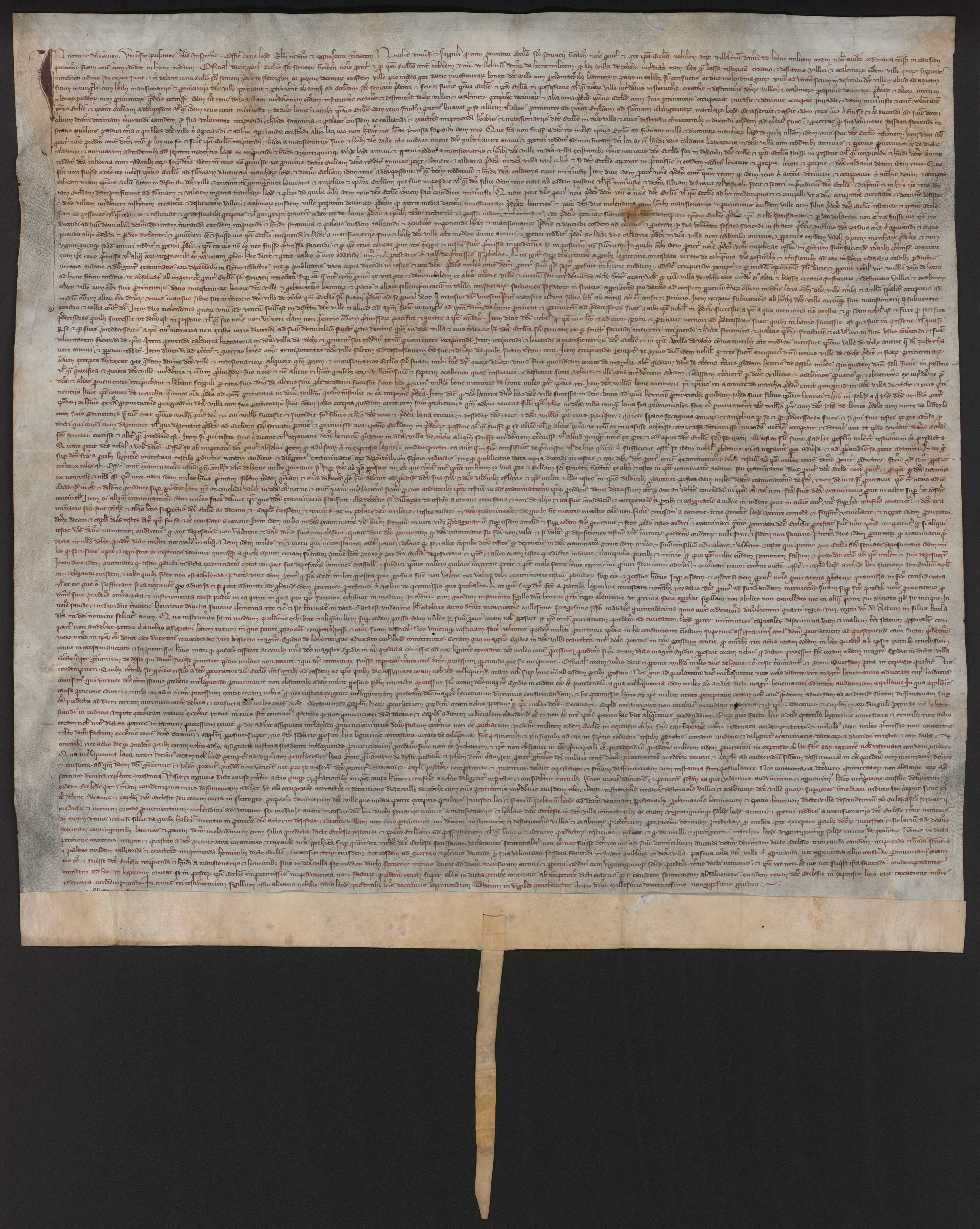
A legal battle between the chapter of St. Servaas and Willem II of Horn over rights and land ownership in Weert in 1295.
On 21 September 1062, Roman catholic King Hendrik IV, in the presence of a number of imperial magnates, confirms a grant by Otto, Count of Thuringia, and his wife Adela of an estate, including possessions and rights in Dilsen and Weert, to the Chapter of St. Servaas in Maastricht (charter no. 1).
This grant was subsequently called into question by Willem II of Horn (1245-1300), who sought to expand his secular power in Weert and its environs. His infringements on the chapter's rights forced the chapter to file a suit against Willem II with the ecclesiastical court in Liege, which ruled on 21 May 1295 (charter no. 75).
This statement is remarkable in that it gives a complete picture of the romano-canonical procedure, as it was common at the end of the 13th century before the ecclesiastical court in Liege, and the legal quirks which were brought to the fore.
Why was the chapter's complaint brought before an ecclesiastical court and not a secular one? The answer lies in the universal jurisdiction of the Church in all matters in which interests of the Church were involved: the so-called causae spirituales and causae spirituales annexae, spiritual matters (pastoral care) and related occasions (including the material rights of the Church).
Why was the romano-canonical procedure followed? The Church lived by Roman law and basically followed the procedural law of the later Roman imperial period, the inquisitorial procedure, a rational procedural form, in which the ascertainment of material truth was central and the judge played an active role. In this respect, ecclesiastical jurisprudence differed from secular jurisprudence, which for a long time still used the accusatory form of procedure, in which the judge was passive and parties settled their dispute by taking oaths and invoking divine judgements.
In the charter of 21 May 1295 the the ecclesiastical judge of the diocese of Liege gives a step-by-step account of the course of the proceedings between the chapter and Willem of Horn, before passing sentence. Essentially, the dispute boils down to this: the chapter accuses Willem of Horn of infringing on the rights of the chapter in Weert. The chapter demands that in future he refrain from doing so and that he compensate the damage suffered by the chapter for lost income. The defendant, Willem of Horn, of course denies the chapter's complaint and states, on the contrary, that he was traditionally entitled to do so.
The chapter therefore asked the judge of the ecclesiastical court to administer justice, especially since Willem of Horn was siad to have already admitted to being at fault in the presence of righteous people.
Willem of Horn replies in court that the chapter's complaint is unfounded and that he possesses full jurisdiction in Weert. He cites open and peaceful possession for more than sixty years by him and his predecessors, Counts of Horn and Altena. If the chapter and their witnesses dare to claim otherwise, they are committing perjury and giving false testimony. He therefore demands that the judge declare the complaint unfounded and that the chapter be ordered to pay the costs.
After the basis for the litigation(litiscontestatio) had thus been established, witnesses were heard and challenged on both sides. Thus the chapter's procurator argued that Willem of Horn, contrary to the rules of canon law, had allowed witnesses to be heard in Weert and other places suspected by the church, the deacon and the chapter, whereas these witnesses could easily have come to Liege to make their statements before the ecclesiastical judge. The chapter therefore claimed that the witness statements in favour of William of Horn were null and void. Moreover, there was said to have been coercion and bribery. In addition, Willem of Horn wwa said to have threatened witnesses who wanted to testify in favour of the chapter. Because Willem's witnesses were people of ill repute, frivolous and perjured, including fornicators, adulterers and ecclesiastically excommunicated persons, the chapter asked that their statements be declared invalid.
To provide evidence of their right, the chapter produced the original grant deed dated 21 September 1062.
In response Willem of Horn's attorney stated that his client did not dare come to Liege in person, due to mortal danger, unsafe roads and political unrest, and requested the judge of the ecclesiastical court to offer him a safe place where he could appear in person to plead his case. The judge honoured that request and designated Maastricht as the place to continue the case, instructing Master Gilles of Liebertenges to temporarily replace him as judge.
Afterwards, when the judge of the ecclesiastical court again presided as judge, Willem of Horn declared that the proceedings in Maastricht did not stand, whereupon he demanded that the chapter be denied its claim and that it be ordered to pay the costs of the proceedings.
Thereupon, the judge on the ecclesiastical court entrusted his function once again to a substitute, Master Henneman, an attorney from Liege in Maastricht, who ruled against Willem of Horn in an interim judgement, after which his attorney appealed to the Liege judge of the ecclesiastical court, who confirmed Master Henneman's judgement.
At this Willem of Horn went on the attack, claiming that the chapter had no authority to litigate against him, since the deacon and chapter were allegedly excommunicated to the highest degree. By interim judgement the judge on the ecclesiastical court then determined that Willem of Horn had not proved the alleged excommunication and ordered him to pay the costs.
This again went against the grain of Willem of Horn, who commenced new proceedings against the chapter on this matter, until the judge on the ecclesiastical court ruled in this as well and determined that the trial on the chapter's original claim should continue.
On the day of the final judgement, Willem of Horn was absent. Nevertheless, on the grounds that the divine presence compensated for Willem of Horn's absence, the judge on the ecclesiastical court ruled in favour of the chapter. He prohibited Willem of Horn from further infringing on the chapter's rights in Weert and obliged him to pay damages and litigation costs.
Willem of Horn, was obviously not happy with this verdict, and his successor Gerard of Horn (1300-1331) subsequently submitted the case again, this time before ecclesiastical arbitrators in Utrecht, who recorded their decision in a new charter on 19 December 1306.
partners



donors