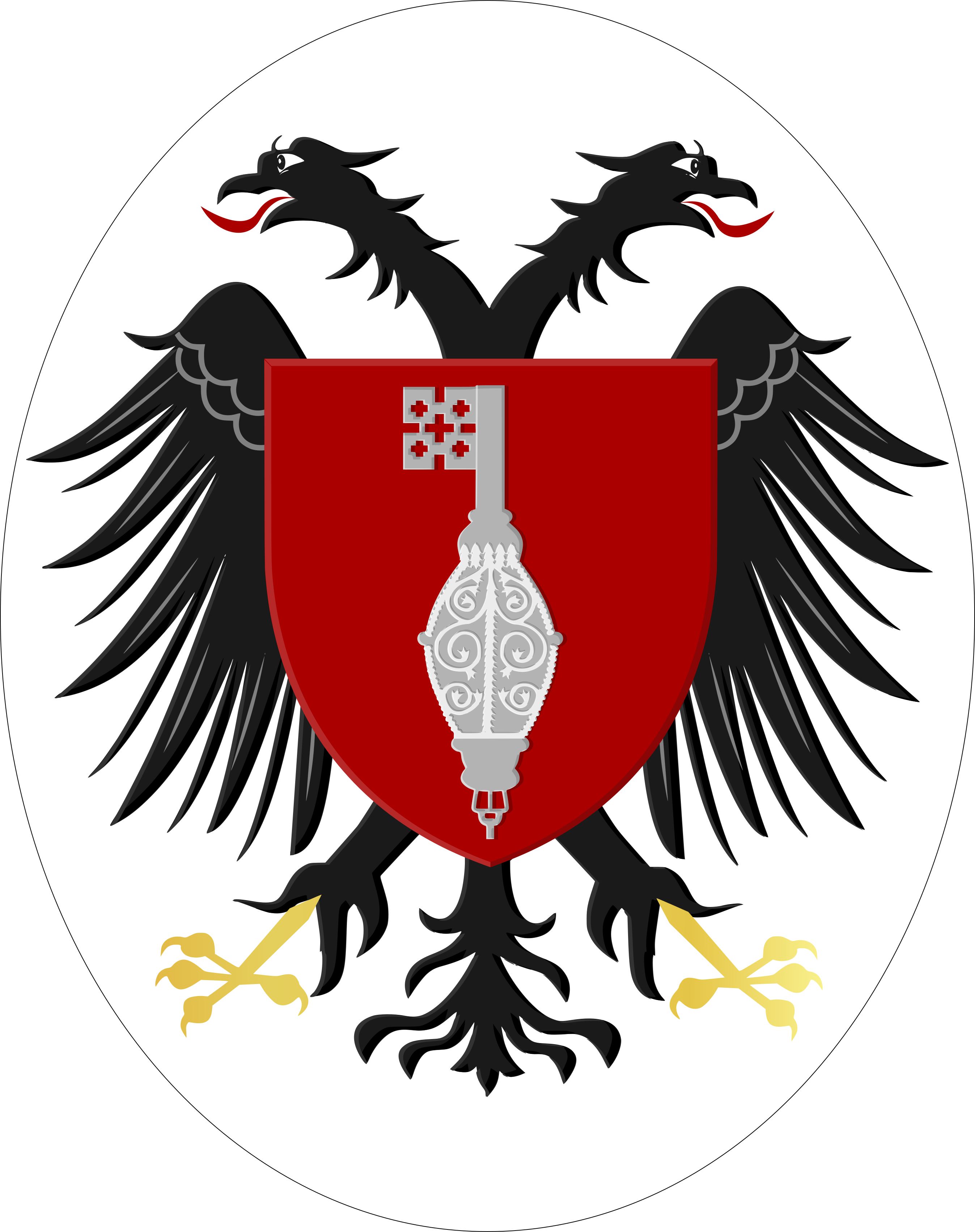
The foundation of Kloosterrade and its development into an abbey

Right on the present-day border between the towns of Kerkrade in the Netherlands and 's-Hertogenrade in Germany there are the buildings of Kloosterrade Abbey. The element "rade" appearing in these names is a younger variant of the toponym "red," a form etymologically related to a verb meaning "to grub up," "to clear," or "to clear the ground of trees and roots". This indicates that these areas were forested. Here in 1104 he priest Ailbertus (± 1065-1122) appeared, who came from Wallonia, in search of a place where he could realise his life's goal, namely achieving the ideal poverty of being a hermit. Ailbertus was a scion of the noble lineage of the lords of Antoing near Tournai on the Scheldt. He was educated at the chapter school in nearby Tournai, where he became proficient in philosophy and applied himself to the seven liberal arts. After his education and priestly ordination, he remained attached to the cathedral chapter as a canon and was a teacher at the cathedral school there. In the days of Ailbertus there was growing interest in the ideas of church reform initiated by Pope Gregory VII (1073-1085). In the circles of canons the desire for a strictly regulated life of asceticism and in total poverty became stronger and stronger. This renewal movement did not leave the Chapter of Tournai unmoved either. Ailbertus himself became so influenced by this Christian ideal of poverty and abstinence and inspired by the life of the apostles and the first Christian congregations that he gave up his life as a canon and left Tournai. Together with his brothers Walgerus and Thyemo, he went in search of a place between Meuse and Rhine, suitable to devote himself to a life of contemplation and mortification, of work and prayer. Close to the castrum Rodense, the fortress of Rode in 's Hertogenrade, he recognised the place that had "previously been repeatedly shown to him by God in his dreams," as the writer mentions in the Annales Rodenses, the twelfth-century chronicle describing the first decades of the abbey. Landlord Count Adelbert of Saffenberg, lord of the castle of Rode, ceded a piece of land on which Ailbertus and his brothers built a hermitage as their lodging. Walgerus left shortly thereafter as a pilgrim to Jerusalem, while Ailbertus with Thyemo devoted himself to manual labour and helping the poor. For the celebration of worship they built a chapel of wood which was demolished in 1106 and replaced by a presbytery with a stone vault on the site of the present crypt. Attracted by the fame of his holiness, local residents from the neighbourhood came in large numbers to ask him for counsel and prayer. Lay brothers and sisters joined the religious community. This included the wealthy minister Embrico from Mayschoss on the Ahr who, with his wife Adeleida and his children Heriman and Margaretha, joined Ailbertus and his followers. On that occasion Embrico transferred all his possessions, his serfs, fields and vineyards to what had now become a fledgling monastic community. Ailbertus was seen there not only as a founder, but especially as verus doctor animarum, a true teacher of souls.
From the contribution of his entire property Embrico derived a certain authority and thus gained influence over the course of events. He managed to persuade Ailbertus to demolish the stone chapel, and on the same site construction was begun on a larger church that would consist of a crypt and an upper church. One year later, on 13 December 1108, Bishop Otbert of Liege dedicated the crypt to Mary and the Archangel Gabriel. On that occasion Otbert issued a charter bearing the date of the dedication day. In this charter, the authenticity of which has been disputed for many years, the bishop of Liege recognised the community of Rode and granted the monastery ecclesiastical immunity for all land holdings. At the same time Otbert granted the community the right to freely choose their superior, baptise children of freemen, admit to communion and bury them. In turn, lord Count Adelbert of Saffenberg granted secular immunity for all his possessions in the land of Rode that he had donated. The acquisition of secular and ecclesiastical independence marked the decisive step towards an existence as an independent monastery. The charter of 13 December 1108 can therefore rightly be considered the founding charter of the abbey.
Embrico envisioned a large and grand men's and women's monastery, and he wanted to use the monastery's property for its construction. This put pressure on the ideal of Ailbertus. Because of disagreements between them, the relationship between the founder and Embrico and Adeleida became increasingly strained. These tensions manifested themselves in two ways. Because of the many donations, the abbey's assets were constantly increasing. True to his ideal of living in complete poverty, Ailbertus wanted to use this to alleviate the plight of the poor, while Embrico wanted to spend it on the further construction of the church and monastery. Yet above all, for Ailbertus the presence of women, the so-called sorores, within the community was incompatible with his views on monastic life. Since 1109 the number of converses increased steadily, and so did the group of women within the community. Adeleida, Embrico's wife, had taken charge of these monastic nuns. Ailbertus toyed with the idea of providing the nuns with their own accommodation near the church of St. Lambert in Kerkrade. However, Adeleida rejected this plan, supported in this by her husband Embrico. Realising that his original ideal could not be realized and that he would not be able to live in unity with Embrico, Ailbertus decided to leave the community, only seven years after he had experienced the place where he had thrown himself to the ground in 1104 as having been appointed to him by God. He headed south to northern France where he founded a new hermitage at Clairefontaine near Vervins to continue his life in solitude in accordance with his original ideal. Passing through to Kloosterrade in 1122, because he wanted to visit friends and acquaintances in this region, he died, aged 42, at Sechtem near Bonn on 19 September and was buried there in the cemetery next to the church.
After the departure of Ailbertus, the remaining monks sought a superior who could structure the community in the spirit of Ailbertus. In Richer, a monk from the abbey of Rottenbuch in distant Bavaria, they found their new superior. Rottenbuch was a thriving reformist monastery of Augustinian choristers, a monastic community that had emerged from the ecclesiastical reform movement that Ailbertus had already joined as a canon in Tournai. The canons drew inspiration for leading a vita apostolica from the example of St. Augustine, to whose way of life and community of life two precepts had been attributed. Consequently, within the regular canons, different observances had arisen with varying degrees of strictness. Besides a moderate form, the so-called ordo antiquus, a strict direction developed, the ordo novus. This was characterized by absolute silence, obligatory manual labour and complete abstinence from meat. The abbey in Rottenbuch belonged to the moderate direction, and Richer introduced in Kloosterrade the rule of order that was observed there. These so-called Consuetudines which laid down the customs and habits that belonged to the Regula Sancti Augustini determined how daily affairs were regulated. Among other things, they obliged the canons to pray the hours together and to perform daily services. In 1119 the new superior received the abbatial blessing from the hands of Frederik of Namur, the bishop of Liege. Until then he had held the title of prior. From this time onwards, with an abbot as its superior, there is talk of Abbatia Rodensis, the abbey of Kloosterrade.
Soon after his election Richer manifested himself as a supporter of a stricter observance of the monastic rule. Already in the same year in which he was promoted to abbot, he made changes to the Consuetudines .Among other things, the modifications concerned meals. Until then the monks had been allowed to consume meat three times a week according to Augustine's rule. Now they had to completely refrain from its enjoyment. In this way Abbot Richer embraced the ideas of the ordo novus, the direction in which asceticism and abstinence were given a greater role. He placed high demands on the religious development of the converses, which he allowed only to a limited extent. His attitude toward the sorores did not differ from that of Ailbertus, and when he too failed to find a suitable place for them elsewhere, he limited their number to a maximum of eight.
At the same time Richer sought close ties with monasteries and individuals who were sympathetic to the reform movement. The stay of Norbert of Xanten, founder of the order of Norbertines, in Kloosterrade in the years between 1115 and 1119 is characteristic of the developments under Richer and of the fame and charisma that the young abbey had already acquired in the meantime. Norbertus meticulously studied the Consuetudines as practised at Kloosterrade. The way in which Richer and his canons lived greatly inspired Norbertus in drafting the monastic rule for his own order, which he founded in 1120. Likewise, Archbishop Koenraad of Salzburg's appeal to Richer in 1121, asking his advice in reforming the cathedral chapter there, underscored the acquired prestige of Kloosterrade. Richer sent him four very capable and experienced canons.
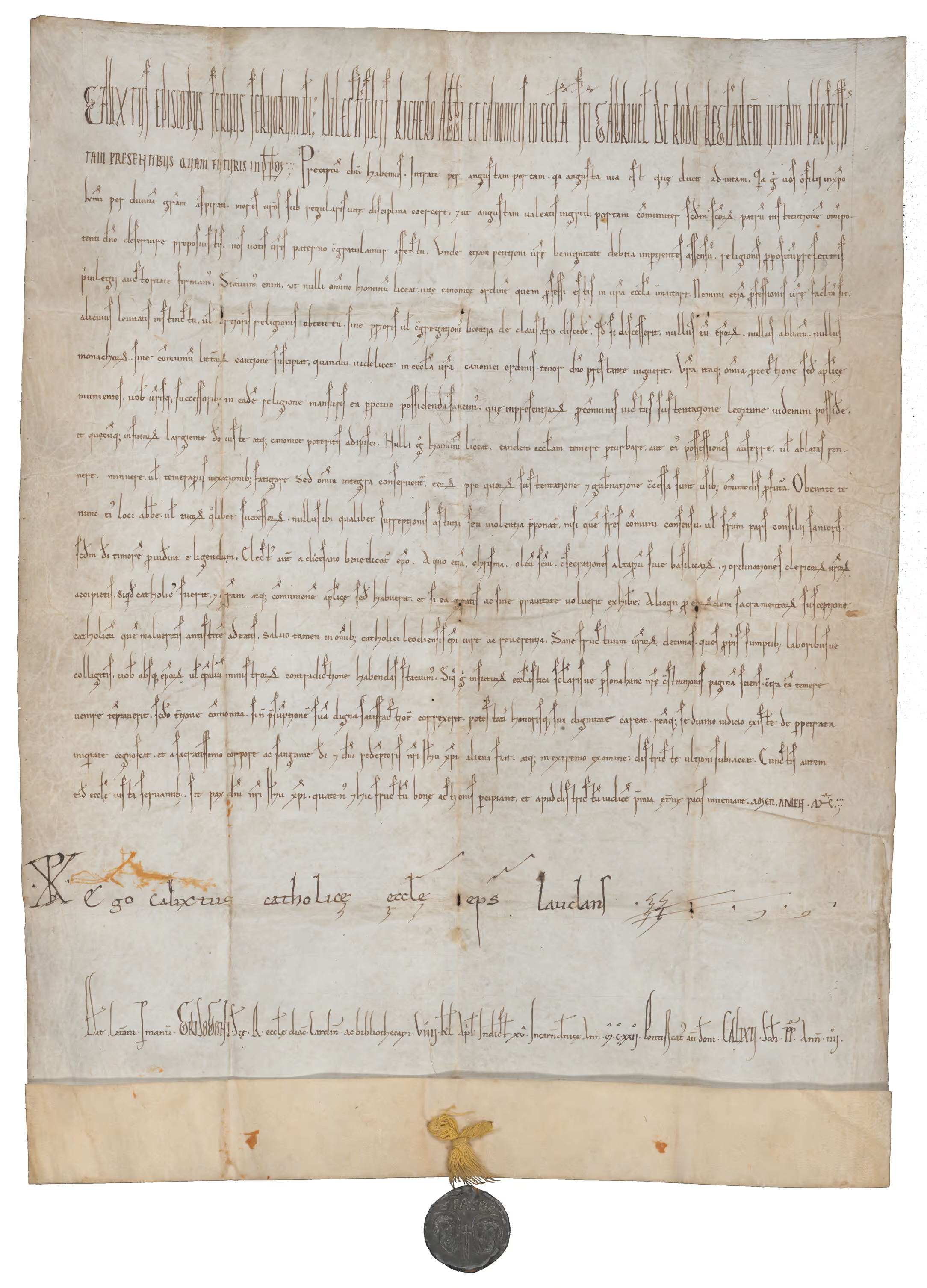
On 25 March 1122 Pope Calixtus II signed the bull addressed to "Richero abbati et canonicis in ecclesia Sancti Gabrielis de Rodo" in which he approved the Rule of Life as formulated by Richer. Calixtus personally signed this charter with the words: Ego Calixtus catholice ecclesie episcopus laudans. Part of the lead seal is still present. However, Abbot Richer was no longer able to read this acknowledgmen, as he died on 5 February 1122. The founder Ailbertus would die a few months later, on 19 September.
partners



donors