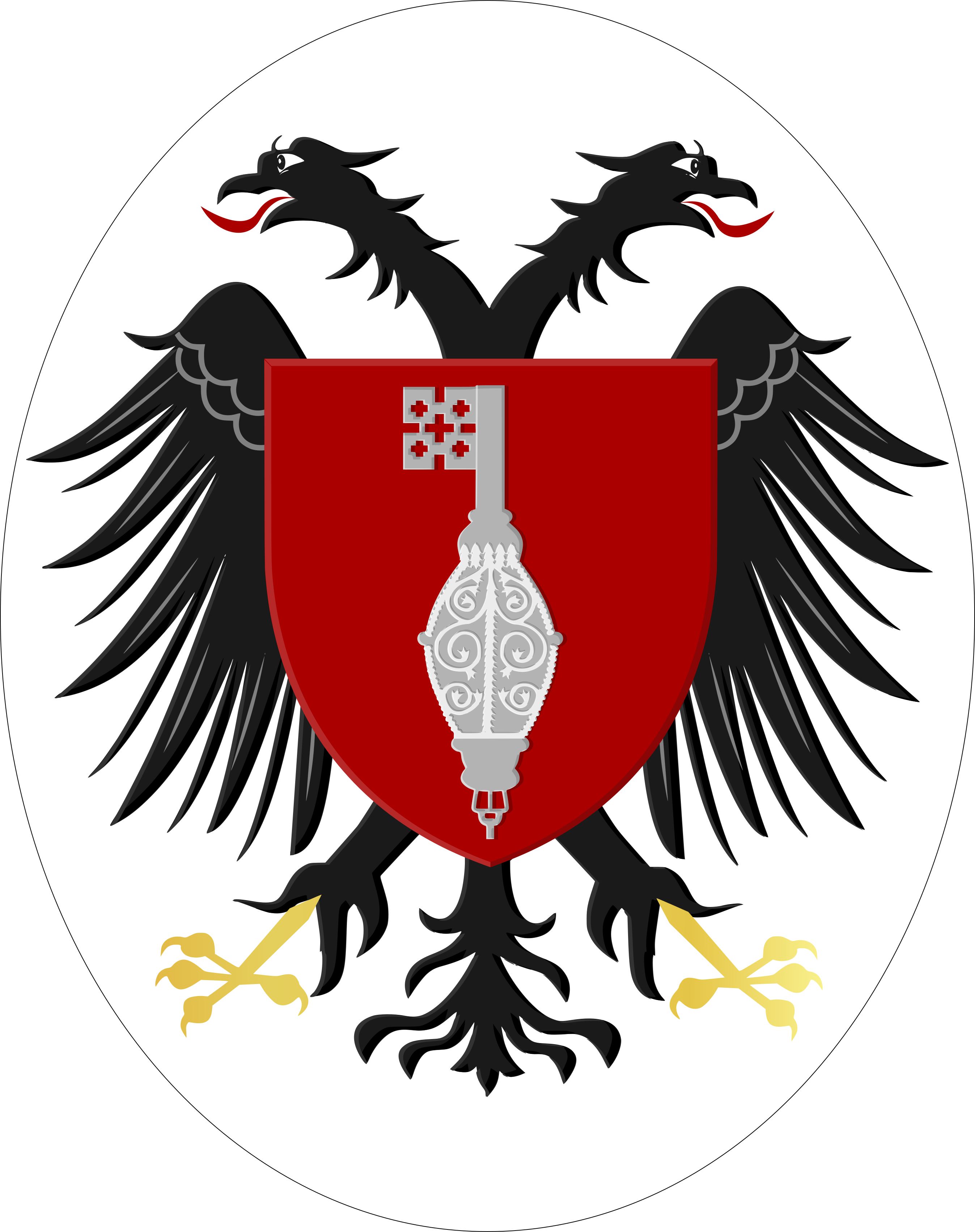
Property and rights of Thorn Abbey in the early years of its existence

Introduction
Ansfried - with his wife Hereswind (Hilsondis) - founded an abbey in Thorn sometime in the last quarter of the 10th century. The foundation can be considered a family monastery, presided over by Benedicta, the founders' daughter. Such a foundation or shrine not only increased the prestige of the family, but family members found their final resting place there, and their memory was kept alive by the prayers at their intention.
Donations of land and rights served to give the family-based monastery a solid basis for existence. The idea was that this would keep the abbey viable in the long run.
Medemblik, 'Lower Maasland' and 'Friesland'
The chronicle of Thietmar of Merseburg states that Ansfried "(gave) everything to St. Lambert for his soul's salvation." This is sometimes interpreted as a transfer of the abbey by the founder to his friend Notger, bishop of Liege. This Notger appears several times in the history of the monastery. Not only was he involved in the completion of the Romanesque westwork of the abbey church, he was also an important player in the acquisition and transfer of goods and rights by the abbey. Thus he appears as a beneficiary in a transfer of the important county of Huy by the very young Roman King Otto III in 985. This acquisition by Notger looks quite spectacular, because Ansfried had renounced it shortly before. Some historians see in it Ansfried's first steps on the way from a secular to a contemplative spiritual life. Others interpret it more as an exchange in connection with the latter's acquisition - also in 985 - of goods in Medemblik, "Lower Maasland" and "Friesland. This is a donation to Ansfried by the aforementioned Otto III, made at the intercession of his mother Theophanu, which also involved Notger (charter no. 2). Theophanu wished to obtain Ansfried's support in politically uncertain times due to the sudden death in 983 of her consort Emperor Otto II.
Later, in a charter from 1292, we find the "Dutch-Frisian" goods as property of the Thorn abbey, and they are confirmed in that capacity by Roman King Adolf (charter no. 61). This charter states that at that time they are located in the diocese of Utrecht and that "the abbess and convent of the abbey of Thorn (are) permitted to possess everything expressed herein as a privilege, peacefully and quietly, with the right and custom as the count (i.e., Ansfried) used it, without any impediment." It is questionable whether this affirmation corresponded to reality, because nothing is known either from that time or from later times about goods of the abbey in "Holland". Probably they copied an old text indiscriminately.
Bree, Ophemert and Kerk-Avezaath
The foregoing is not the only (early) transaction of the abbey in which Notger was involved. A charter of 1007 attests to the confirmation of Notger's earlier donation of the churches of "Britte" (Bree or Beek?), Ophemert and Kerk-Avezaath. The abbey is confirmed in its possession by Roman King Hendrik II. It is termed quite eloquently that this is done "for the increase in ecclesiastical revenues and increase in heavenly remuneration" (charter no. 4). Uncertainty exists regarding the geographical designation "Britte". Some see it as the later town of Bree, others the village of Beek, located near Bree.
Hendrik II did not limit himself to immovable property. In the same charter he also grants the abbey market and toll rights and the so-called "districtum". A recent study has linked the three granted rights. These are said to be royal rights, with legal powers for the abbey not only to organise a market, but also to guarantee "market peace" and to levy taxes on the goods traded. The abbey and surrounding area thus gets independent legal immunity, having its own law, which becomes the basis for the later imperial immunity, dependent on no secular ruler, status in the Holy Roman Empire.
Perhaps by 1300 some discussion arose about the legality of some of the abbey's possessions, for in the same year as the "Dutch-Frisian" goods, namely 1292, its goods and rights concerning the churches of Britte, Ophemert and Kerk-Avezaath are also confirmed by Roman King Adolf (charter no. 62). And the same royal recognition also applies to the rights of market and toll right and districtum.
The properties in the West Brabant area
While many goods and rights acquired by the abbey in its early period can be easily traced back to their origin, this is not true of its extensive possessions in West Brabant, near Breda. The question of their origin inevitably leads us to the founding charter of 992 (charter no. 3). However, this one is irrefutably a 17th-century falsification. Nonetheless, at its core it represents ideas, as developed later in Thorn, about the acquisition of ancient possessions in "the far west".
The charter speaks of the foundation as a "common work" of the spouses Ansfried and Hereswind (Hilsondis). The latter did not hesitate to contribute goods and rights from her own property: the Mariakerk in Strijen, Geertruidenberg, the "villa" Gilze, the "villa" Baarle with the St. Remigius altar she founded, the "castellum" Sprundelheim with accessories and a forest "between the two Marches" and furthermore all rights of toll, mill, property tax and road and waterworks, as she herself and her parents had owned and formerly received from King Swentibold. Although this enumeration has been the subject of extensive historical criticism, it is an established fact that the abbey arguably possessed a "curtis" and other properties in Gilze from the early 13th century onward, that it owned extensive lands, tithes, and property tax rights in Baarle (one curtis of which is also here, the "hof te Loeven te Baerle" being the centre) and that she owned tithes and curtis in Ginniken, Princenhage, Breda, Bavel, Meersel, Meerle, Meer, Etten, Leur, Sprundel, Alphen, Ulicoten, Rijen, Oosterhout, Wouw, Drimmelen, Ulvenhout, Chaam and Galder. In charter no. 68 of 1299, many of these possessions are mentioned in an agreement between abbess Guda of Rennenberg and the convent and, on the other hand, Jacob, parish priest of Gilze.
Historians believe that, despite being a forgery, the purport of the foundation charter of 992 need not be doubted. A transfer of original property in West Brabant by Hereswind/Hilsondis to the abbey, in whatever form, is quite possible.
In conclusion
We may note that in its early existence the abbey of Thorn was endowed with goods and rights, scattered here and there in what is now called the Netherlands, Belgium and Germany. This very quickly gave the abbey an economic foundation. Often the properties and rights were disputed by secular rulers. Nevertheless, the abbey managed to resist these attacks, often with the help of an extensive noble and legal network until the end of its existence in 1794.
partners



donors