St Augustine's rule and work in pastoral care
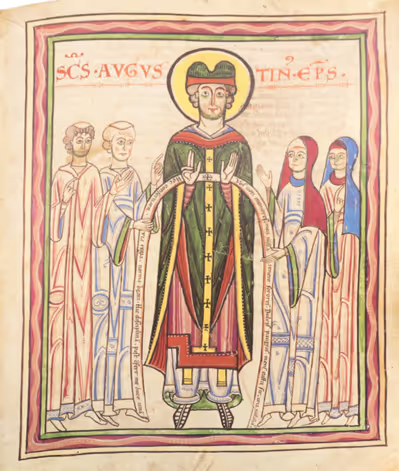
The church reform initiated by Pope Gregory VII in the 11th century resulted, among other things, in a growing popularity of the Rule of St. Augustine among clergy and laity. In the circles of canons at both cathedral and chapter churches, the pope's initiatives fell on fertile ground. Among these canons a strong desire grew for a way of life based on the life of the apostles in the oldest Christian congregations, the vita apostolica, which served as the standard for a truly Christian existence. Even within the Chapter of the Church in Tournai, there was a desire to deepen religious life. Ailbertus, the founder of Kloosterrade, had received his education here at the chapter school and had later become chapter lord there.
The reform movement eventually led to a distinction of canons into two distinct groups: firstly, secular canons attached to the chapter of a cathedral or collegiate church, and secondly, regular canons living in a monastic community. However, from the beginning St. Augustine's Rule was interpreted in different ways, so opinions and practices varied, resulting in the fact that it was difficult to speak of an authentic Augustinian tradition. Within the group of regular canons, different observances with an equally wide variety of monastic rules and regulations emerged as a result. Part of the regular communities of canons adopted the ordo antiquus, the ancient direction that advocated moderate strictness. This offered room for individual interpretation of monastic life, but also for attention to general services outside the monastery. In addition, a new, much stricter direction developed, the ordo novus. Influenced by the strict spirituality inherent in monasticism, great priority was given in this direction to the complete abstinence from meat, to complete silence, to the wearing of woolen clothing instead of linen and to the obligatory performance of manual labour.
The question of whether there was also a task for regular canons in pastoral care, in addition to this strongly monastic and contemplative monastic life, was answered in the negative at Kloosterrade Abbey at the beginning. In 1115 Abbot Richer refused to allow the church of nearby Rode, today's Kerkrade, to be served by one of the abbey's canons. This characterised the abbot as a representative of the ordo novus, the direction among the canons that considered contemplative monastic life with its inherent worldliness and asceticism incompatible with participation in pastoral care in parishes. His immediate successors held similar views. When the popes emphatically declared themselves in favour of a commitment of regular canons to the church reforms initiated by Pope Gregory VII, Kloosterrade Abbey became more open to the outside world.
The willingness to act as priests was first manifested in 1140, when Abbot Johan made the decision to exercise pastoral care and began entrusting the ministry of the church in neighbouring Kerkrade to canons of Kloosterrade. Until then secular clerics there had been placed in the post of priest by the archdeacon of Haspengouw. According to the annalist (= writer of year books / historical accounts), disagreement had arisen between the parish priest and the abbey in 1140. In order to resolve this disagreement, Abbot Johan managed to convince the archdeacon to grant the abbey the right to appoint priests from its own ranks to the parish church of Kerkrade. Until the French era the parish priests of Kerkrade were canons of Kloosterrade.
While Kerkrade was the first parish church where Kloosterrade provided pastoral care, the church of Goé, a place between Verviers and Eupen, not far from Limbourg, followed five years later. The Annales Rodenses mention that a certain Hendrik entered the monastery with his brother Frederik and contributed their possessions on that occasion. These included the church of Goé and a chapel named Bilstain. In a charter from 1147, the original of which comes from the archives of the Sinnich convent, Bishop Hendrik II of Liege confirms the acquisition of these goods. It is not clear whether a canon from Kloosterrade was also immediately appointed priest in Goé at that time.
In 1151 Duchess Jutta, widow of Duke Walram II of Limburg, donated the ownership and management of the church of Lommersum, some thirty kilometres south of Cologne. She did this on the occasion of her entry into the convent of Kloosterrade. The Annales Rodenses mention this donation and at the same time report that the duchess died shortly thereafter, on 25 June of the same year, and was interred in the abbey church.
Support for pastoral care grew in the course of the century, and through donations the abbey acquired the patronage rights of more and more churches. By virtue of this right, the abbey of Kloosterrade could nominate canons from its ranks for appointment to certain ecclesiastical offices. A considerable increase in the number of parishes in 1178 resulted from the donation of the patronage rights of the churches of Afden, Doveren and Baelen. The original version of the charter in which Filips I, Archbishop of Cologne, confirms the donation of these churches to Kloosterrade by Hendrik III, Duke of Limburg, on 25 April 1178, has been lost. There is, however, a copy of this from 1222 in the oldest surviving cartulary of the abbey. This medieval register, in which charters are written down because of their evidential value for acquired rights and claims or the administration of property and for the validity of land exchanges, sales or donations, dates from the 12th century and includes transcripts from the period 1122 to 1224. From the parish of Baelen, which was very extensive, daughter churches were then gradually split off again where canons from Kloosterrade also held the office of priest.
The number of parishes from which the abbots of Kloosterrade obtained the right of appointment in the following centuries remained rather modest. They were rural parishes, as urban agglomerations were some distance away from the abbey during the period when Kloosterrade was an abbey. Although the city of Aachen was close by and, like Kloosterrade, under the authority of the bishop of Liege, the abbey did not participate in pastoral care in any of the parishes that city had.
With the exception of the parishes of Doveren, Lommersum and Hersel, the parishes were located in the Voer region, in the vicinity of the two oldest parishes of Goé and Baelen. No records have survived from the early period that provide insight into the interrelationships that the parish priests of Kloosterrade maintained in these parishes. However, the life of canons as pastoral caregivers in the parishes, where they also took care of catechesis for the parishioners, in addition to presiding at liturgical celebrations and ministering the sacraments, must have been in great contrast to the contemplative life within the monastery walls. Nor is it known whether and to what extent they maintained the monastic rules of the mother house in the parish where they lived. The earliest records of the fortunes of the priest-canons date from the 15th century. They depict the decay that had afflicted the abbey itself at that time and had led to an equally severe lack of discipline in the sister monasteries. The various parish archives show that the abbey was not always able to fill vacant priesthoods from within its own ranks. This indicates that the abbey went through periods when the number of resident canons was low. In such situations the abbot had no choice but to appoint a secular clergyman to the vacant post.
Canons of Kloosterrade exercised pastoral care in the following places in the Rhine-Meuse area until the dissolution of the monastery in 1796, when the last choir lords left the abbey for good on 15 December: Kerkrade (1140), Goé (1145), Lommersum (1151), Baelen (1178), Doveren (1178), Afden (1178), Hersel (before 1250), Henri-Chapelle (probably from 1400), Limbourg (1460), 's-Hertogenrade (1564), Eupen (1695), Welkenrath (1695) and Membach (1732).
partners



donors