Contexte des fondations monastiques dans l’Empire allemand
Charlemagne et ses successeurs ont gouverné leur empire avec l'aide de seigneurs féodaux. Au cours du XIe siècle, ils se rendent compte que la féodalisation à grande échelle entraîne l'érosion de leur pouvoir. En conséquence, ils ont perdu le contrôle direct de leurs territoires, au profit des seigneurs féodaux.
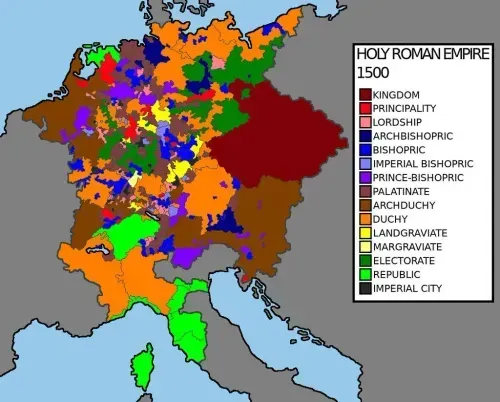
"Cette volonté a conduit, entre autres, à la création de domaines fonciers".
Alors que les domaines féodaux revenaient initialement à l'empereur en tant que seigneur à la mort du vassal féodal, les efforts des féodaux pour rendre les domaines féodaux héréditaires au sein de leurs familles ont érodé le pouvoir impérial. Cela a conduit, entre autres, à la création de territoires gouvernés par le seigneur local, comme le Valkenburg, où l'empereur a de moins en moins son mot à dire. C'est là que sont nées les seigneuries de la fin du Moyen Âge, comme les duchés de Brabant, de Gelre, de Gulik et de Limbourg.
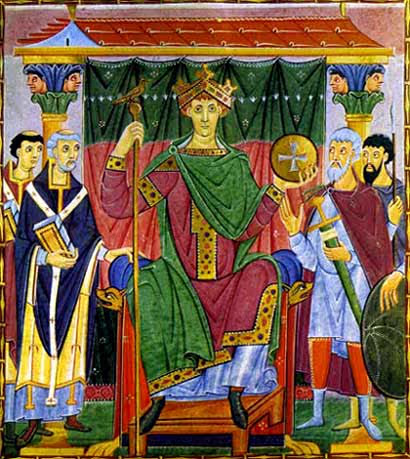
L'empereur allemand Otton III (983-1002) pensait avoir trouvé une solution à ce problème en investissant les évêques et les abbés du pouvoir séculier, puisque le célibat semblait empêcher l'établissement de dynasties en raison de l'absence de descendance.
Depuis lors, cependant, lui et ses successeurs ont accordé plus d'attention aux capacités administratives qu'à la direction spirituelle des évêques et des abbés. Cette politique impériale de nominations a conduit à la controverse de l'Investiture - un conflit avec le pape Grégoire VII (1073-1085) sur le droit de nommer les hauts clercs qui exerçaient le pouvoir temporel ainsi que le pouvoir ecclésiastique - qui a duré jusqu'au traité de Worms (1122).
En 985, l'empereur Otton III fut le premier à nommer l'évêque liégeois Notgerus (972-1008) comme homme lige de l'empire. C'est ainsi qu'il a jeté les bases de la principauté de Liège. Comme la région se situait entre la Meuse et le Rhin, le favoritisme impérial impliquait que, lors des luttes d'investiture, le clergé de la région fût plus favorable à l'empereur qu'au pape.
Les seigneurs féodaux de l'empereur ont suivi plus tard cet exemple, car ils voulaient également assurer une partie de leur pouvoir territorial en accordant des droits seigneuriaux aux abbés et aux monastères, comme les seigneurs de Heinsberg et de Valkenburg, qui ont fondé le monastère de Houthem-St.-Gerlach (1201). En fondant ces monastères, les nobles locaux ont exprimé la conscience de leur capacité à exercer le pouvoir de manière autonome ; ainsi, les monastères et chapitres qu'ils ont fondés dans les premières décennies du XIIe siècle ont contribué à définir et à consolider leur pouvoir territorial.
Avec la fondation de ces monastères, les dirigeants régionaux ont essayé de servir un double objectif. D'une part, ils voulaient s'assurer une partie de leur pouvoir mondain et, d'autre part, ils essayaient d'assurer leur place dans l'au-delà, en faisant, par exemple, de la lecture des messes pour leur salut une condition de leur don. Ils supervisaient également la gestion quotidienne du monastère en nommant un prévôt, qui veillait au respect des droits matériels dont les fondateurs avaient doté le monastère ; ils laissaient la direction spirituelle au prieur ou à l'abbé.
Au fil du temps, les monastères, comme le Norbertinesstift Houthem-St.-Gerlach, ont acquis toutes sortes de droits supplémentaires, souvent sous la forme de dons d'argent et de biens, par lesquels les donateurs tentaient d'assurer leur salut ; ceux-ci étaient formulés dans des chartes, dans lesquelles étaient consignées les conditions du don.
"Au fil du temps, les monastères, comme le Norbertinesenstift de Houthem-St.-Gerlach, ont acquis toutes sortes de droits supplémentaires".
partenaires



donateurs